




 161 / 231

Brasil
PackTrends
2020
161
quality and new technologies
Barrier materials
The polymeric materials are permeable to gas
and water vapor, differently from metallic and glass
packages, and that limit the application for various
products categories. However, the barrier properties
can be improved by using nanocomposites and oxide
coatings.
Nanomaterials (clays, nanofibers, nanoparticles,
etc.) work as small physical barriers to the permeation
of gases and vapor through the polymers, making a
tortuous path of the permeant through the polymer,
slowing down its permeation. When they are present in a
sufficient number, they slow down the mass transfer. The
effective increase of the package barrier depends on the
nanoparticles dispersion on the polymeric matrix. That
dispersion is associated with the polymer, nanomaterial
and compatibility agents, used to disperse the
nanomaterial on the polymer (ROBINSON; MORRISON,
2010). It also depends on the concentration of the
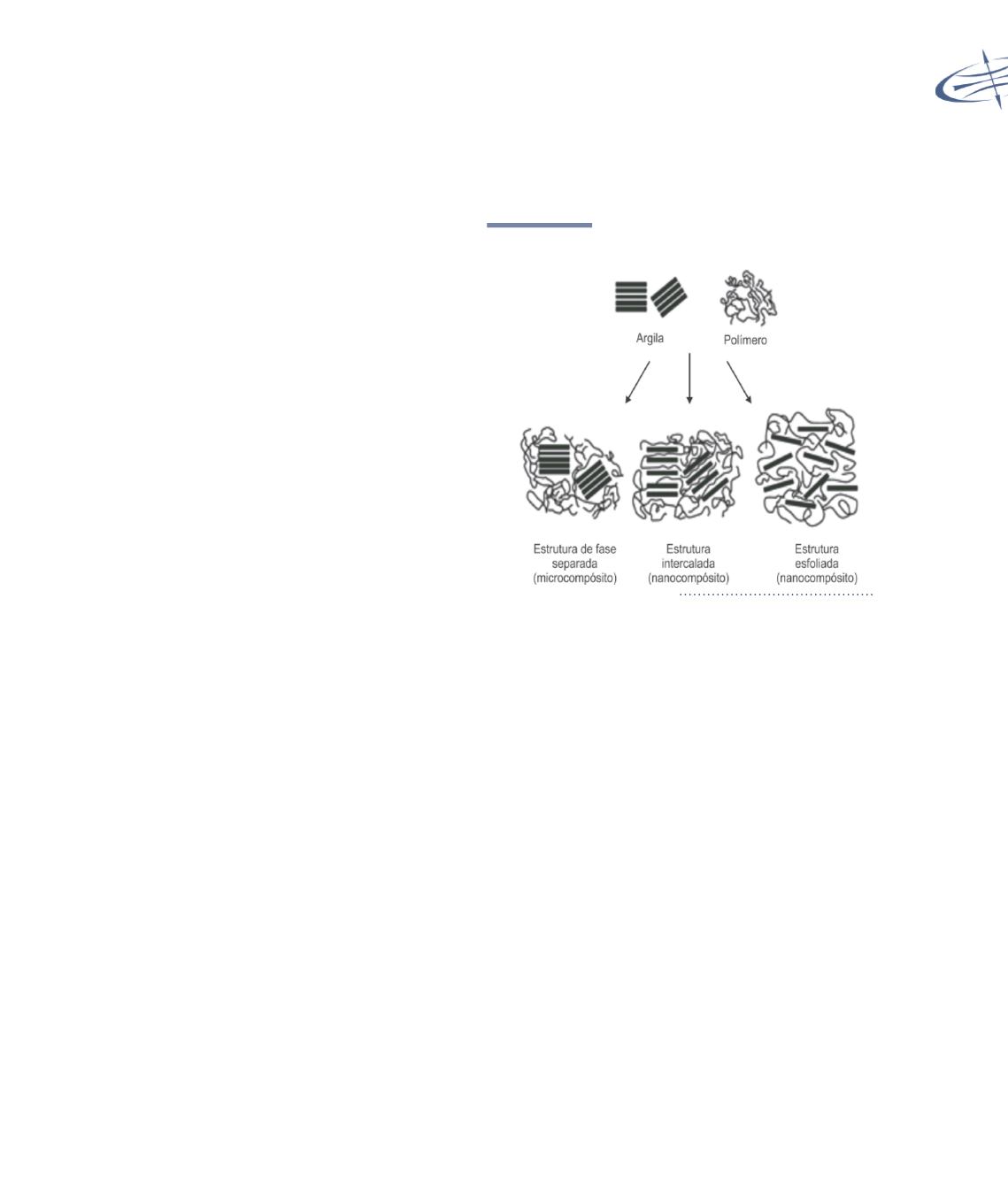
nanomaterial and the degree of exfoliation. If there is
no layers separation (exfoliation and intercalation),
which means that the polymer chain does not penetrate
the nanomaterial layers, a conventional composite is
obtained, with separate phases, immiscibles, in which
the improvement of the mechanical properties can be
verified, but not the increase of gas and water vapor
barriers, just like the nanocomposites (Picture 6.28).
The greater the degree of exfoliation, the bigger the gas
and water vapor barrier.
Although the incorporation of nanomaterials,
especially clays, can be done in various polymers,
the polyamide-based nanocomposites are the most
commercial successful in barrier resins for packaging
(examples: Imperm® by Nanocor® Inc MXD6
polyamide-based and HFX by Honeywell).
The company InMat sells nanocomposite water
base barrier coating - Nanolook, for films. The material
combines polymer with nanoclay dispersed in water.
The coating does not interfere in the biopolymers
recyclability and compostability. It aims at the dry and
oxygen sensitive food markets, such as coffee, nuts and
snacks.
FIGURE 6.28
Structure of nanocomposites
(PAIVA; MORALES, 2006)
The coating of films with silicon oxide SiO
x
through a physicial vapor deposition process with a
good uniformity and adherence provides high humidity
and gas barrier, keeping the package transparency. It is
actually a polymer coating with manometric particles,
usually applied in PET film, or bio-oriented polyamide.
An example of that technology is the film family called
Ceramis, by Amcor. In the field of PET bottles, Toyo
Seikan Kaisha sells the SiBARD technology, which is
a double internal package coating. Initially an organic
silicone film is formed and it provides flexibility and
adhesivity to other internal coating of the silicon oxide,
with good gas barrier properties. The coating is very
thin, does not compromise the recyclability and has
high transparency. Mitsubishi Shoji Plastics uses the
coating technology called Plasma Nano Shield (plasma
enhanced chemical vapor deposition) of amorphous
carbon for high barrier PET bottles.
To increase the light barrier of polymeric
packages, zinc nano-oxide and titanium nanodioxide are
incorporated in polymers as anti-UV agents. DuPont is
selling a titanium dioxide nanoparticle (Light Stabilizer
210) as a barrier to the UV light.