




 166 / 231

Brasil
PackTrends
2020
166
quality and new technologies
One concern is that the competitiveness of
bioplastics would be affected by the pricing increase of the
agriculture products. Another concern is that the cultures
for bioplastics production would cause a pricing increase
and impacts on the food supply (BARNETT, 2011b).
In Brazil, the Brazilian Technical Standards
Association (ABNT) defines biopolymer as “polymer
or copolymer produced from renewable source raw
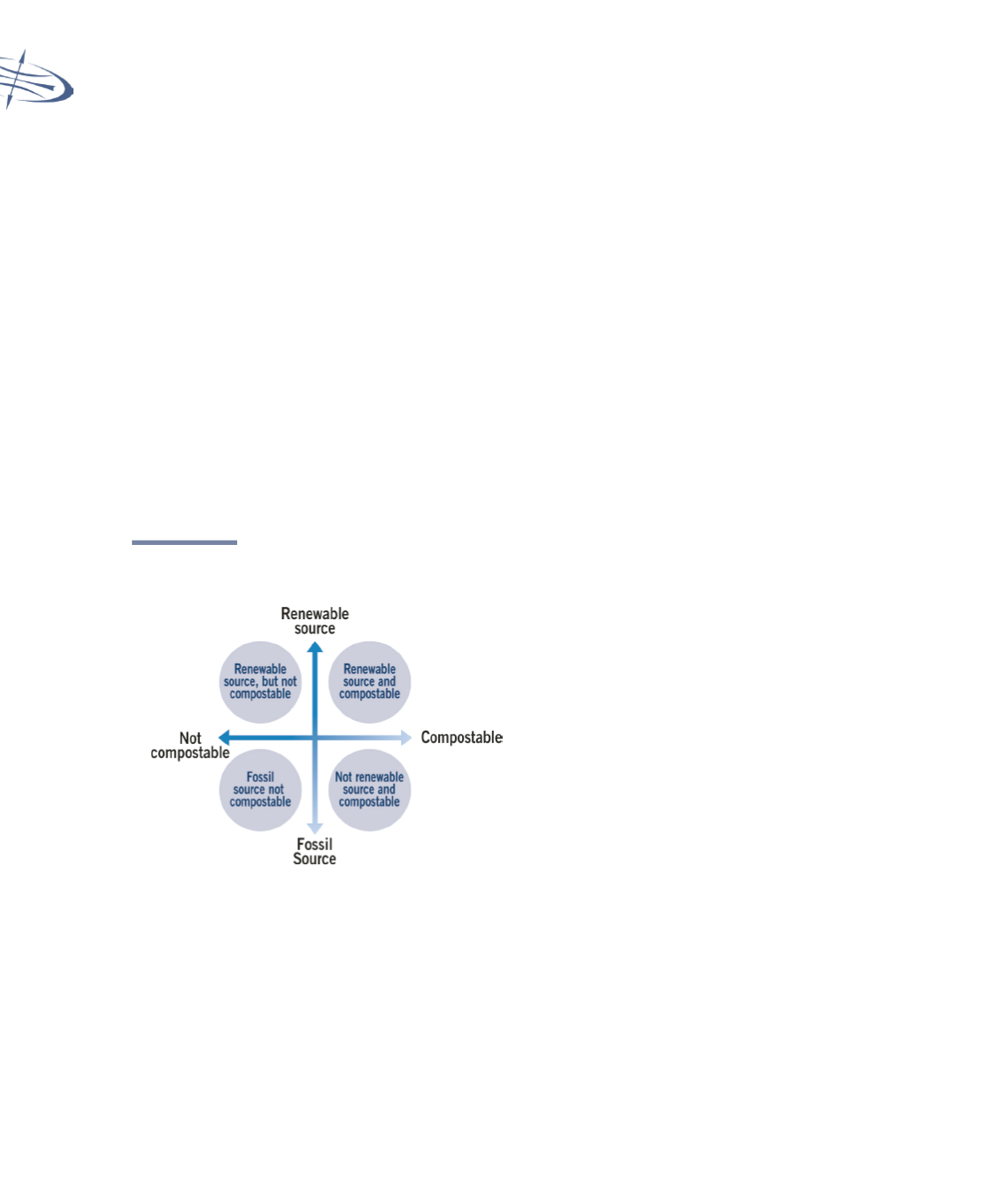
material” (ABNT NBR 15448-1, 2008). In some
countries, the definition of biopolymer is still under
debate and can include, besides renewable source
materials, even though they are not compostable,
compostable materials, even though they are not from a
renewable source (Figure 6.31).
FIGURE 6.31
Concepts that are involved in
the definition of biopolymers
The biodegradation is a process in which organic
substances, or similar synthetic, are degraded by
microorganisms, in aerobic environments, such as
composting, or anaerobic, like most of the landfills.
Biodegradable materials, if correctly composted,
minimize the environmental impacts, once good quality
manure is produced. However, if placed in landfills,
they generate methane when degraded, a 25 times
more potential for greenhouse effect than CO
2
, which
aggravates the environmental problem. Hence, the use
of a biodegradable package demands an infrastructure of
composting and requires that the product manufacturer
assures that the consumer will discard it properly, to
ensure revalorization (HORTON, 2008).
Compostability is the complete biological
degradation of biodegradable material, until the
formation of carbon dioxide, water, inorganic compounds
and biomass, with no toxic waste.
To be certified as compostable biodegradable
material, a biopolymer should meet some standards, in
Brazil ABNT NBR 15448-2 (2008), in USA ASTM D
6400 (2012) and in Europe EN 13432 (2000) and EN
14995 (2006).
The difference between biodegradable-only and
compostable plastic is important. For example, a film
with less than 20μm of PLA is compostable, while
thicker films are not compostable, because they do not
decompose fast enough to be considered compostable
(BARNETT, 2011b).
The process of oxidegradation is associated
to polymers of fossil source with metallic salt-based
additives that catalyzes the degradation of the chemical
structure, generating molecules with lower molecular
mass, non-biodegradable and inorganic particles.
The process is activated by the polymer exposition to
some factors such as heat, UV radiation and humidity.
There is no oxidegradation in landfills with no proper
temperature, oxygen and light. They compromise the
normal recycle chain, because they cause degradation of
the recycled chemical structure and are not composted
at industrial composting plants. Oxidegradable plastics
are not traditionally classified as biopolymers, as they
normally do not meet the ABNT NBR 15448-2 (2008),
ASTM D 6400 (2012) or EN 13432 (2000) standards
requirements, once they take more than 180 days to
degrade at the conditions specified in the standards.
Concerning the biopolymers definition there are
standards that helps in the evaluation of these new
materials, such as the Brazilian standard ABNT NBR
15448-2 (2008), American standard ASTM D 6400
(2012) for composting plastics, ASTM D 6868 (2011)
for paper coatings and other compostable substrates and
the European standards EN 13432 (2000 + AC 2005)
for packages and EN 14995 (2006) for materials,