




 146 / 231

Brasil
PackTrends
2020
146
quality and new technologies
products used as raw materials, the use of food additives
is not allowed. In those cases, the incorporation of
antioxidants into the packaging material would be a way
to protect the food, with controled release of that active
compound, which would work in the headspace and/or
over the product surface in an active package system.
Various formulations of antioxidants for
incorporation into plastic packages have been studied,
such as synthetic antioxidants as BHT (3.5-Di-
tert-butyl-4-hydroxytoluene), BHA (2-tert-butyl-4-
hydroxyanisole), TBHQ (tertiary butylhydroquinone) and
propyl gallate. Immobilized enzymes in plastic packages
can also actively work as antioxidants. Although, in
the manufacturing of plastic packages, one part of
the antioxidant loses its scavenging functionality and
another part may be lost to the environment during the
thermal process due to its high volatility. The antioxidant
concentration in polymeric films also decreases, even
before the packaging use, during storage, due to its
oxidation and by diffusion of the compound to the film
surface, followed by evaporation. Therefore, the emitter
packages have to be normally formulated with a higher
than usual concentration to preserve the product. On the
other hand, the addition of high quantities of additive
in the polymer may alter the optical and mechanical
properties of the packaging.
Related to the humidity control, the active
packages segment shows two distinct lines: one of them
seeks to reduce the relative humidity to the maximum
around dry products (food or pharmaceuticals) and
electronics components, which is obtained by the use
of moisture absorbers (desiccant). The other line aims
to control the relative humidity level around fruits,
vegetables and fresh meat, generally above 75%, using
the moisture regulators or liquid absorbers.
The most common desiccants can be divided
into the following categories: physical (silica gel – SiO
2
,
clay, molecular sieve); hydrated salts; hygroscopic
salts; superabsorbents polymers (polyacrylate sodium,
carboxymethyl cellulose (CMC) and copolymer amide);
and chemically active desiccants – CaO.
The use of moisture absorbing sachets is a widely
used and established technology in the pharmaceutical
market. However, the use of desiccants incorporated
into the package may grow with the development of
new technologies. As an example, the company Amcor
developed a desiccant incorporated into a laminated
film to be used in packages for pharmaceuticals that are
moisture sensitive, extending the product shelf life and
increasing its stability. The desiccant is incorporated
into the sealing layer of the blister, eliminating the need
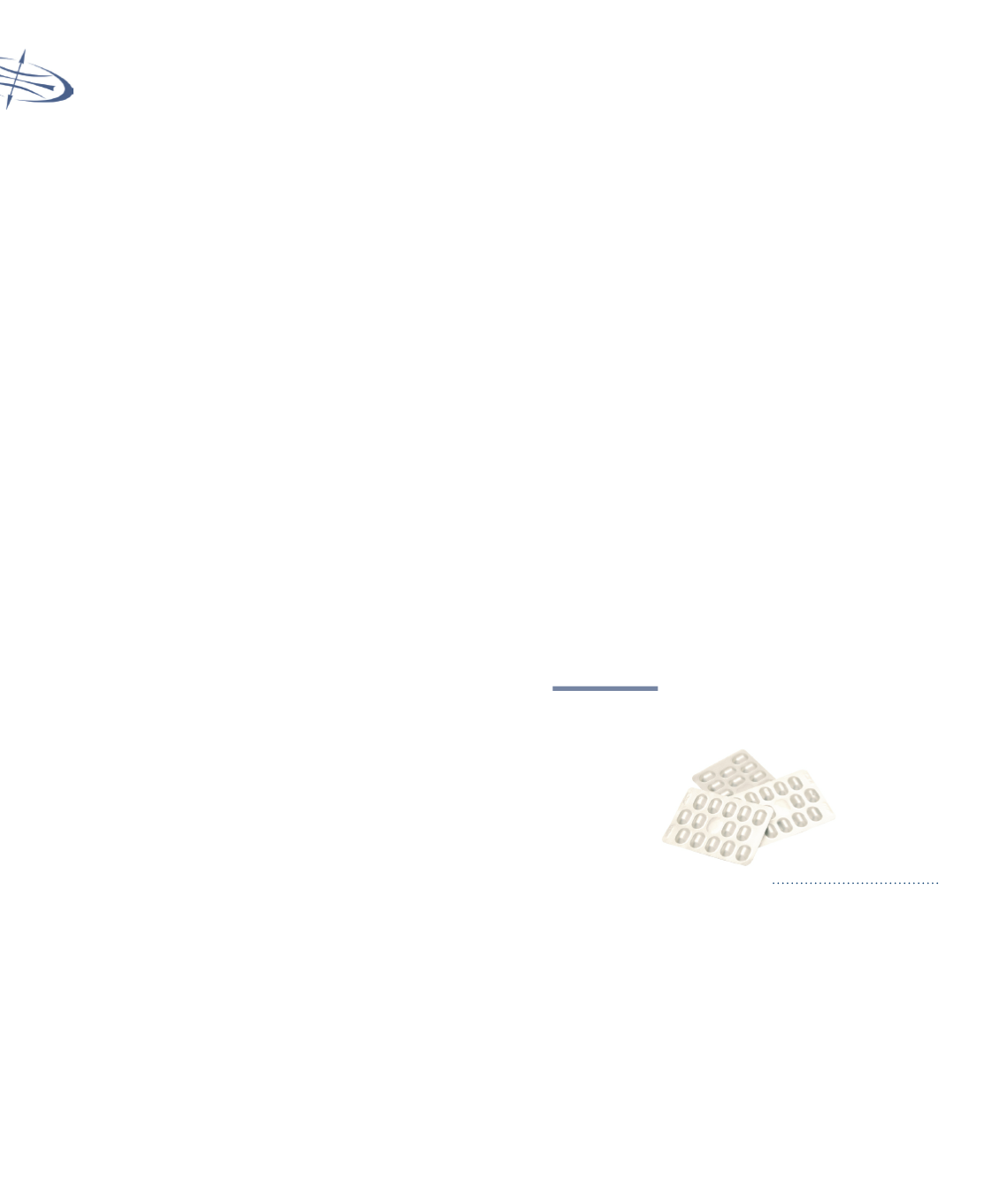
of an extra accessory or material (Figure 6.3).
FIGURE 6.3
Desiccant incorporated into
the Amcor package material
Source: Press Release
The CSP Technologies holds a technology to
the incorporation of active materials into polymers,
resulting in the family ACTIV-POLYMER. A desiccant
material (molecular sieve or silica gel) is incorporated
into the polymer, associated with an agent that promotes
microscopic channels inside the polymer structure which
favor the diffusion of substances such as water through
the polymer. This family of products, commercially
called ACTIVE-PAK, has three components: a polymer
(hydrophobic): PP or PE; a channel former agent
Moisture absorbers and controllers