




 149 / 231

Brasil
PackTrends
2020
149
quality and new technologies
The incorporation of finely spread minerals in
polymers is generally done in low density polyethylene,
but it is also observed in the market the incorporation
in polyamide and polyethylene blends. The mineral is
encapsulated in particles by the polymer, forming a
maze among the polymeric chains, which can adsorb
gases like ethylene. Most of those films are opaque
and have limited absorption capacity for that gas. The
choice of the polymeric substrate must always consider
the permeability to the vegetable respiration gases
for which it is designated or use a perforated film,
to avoid anaerobic conditions, which accelerate the
deterioration of fruits and vegetables and can even bring
risks of pathogenicity. Companies such as PEAKFresh,
Bio-Fresh, Evert-Fresh, Amcor and many others sell
active films for application in home packages, in bulk
packages and for pallets covering.
Besides promoting the ethylene absorption,
the incorporation of certain minerals in polymers may
also increase the films permeability, in a way that the
ethylene and the CO
2
leave the package faster and
the oxygen gets in faster as well, affecting a little of
the vegetable physiology, due to a small change of
the atmosphere inside the package, in relation to the
air. Those changes in the permeability may reduce
the concentration of ethylene inside the package
headspace and, consequentially, increase the shelf life,
independently of any ethylene absorption.
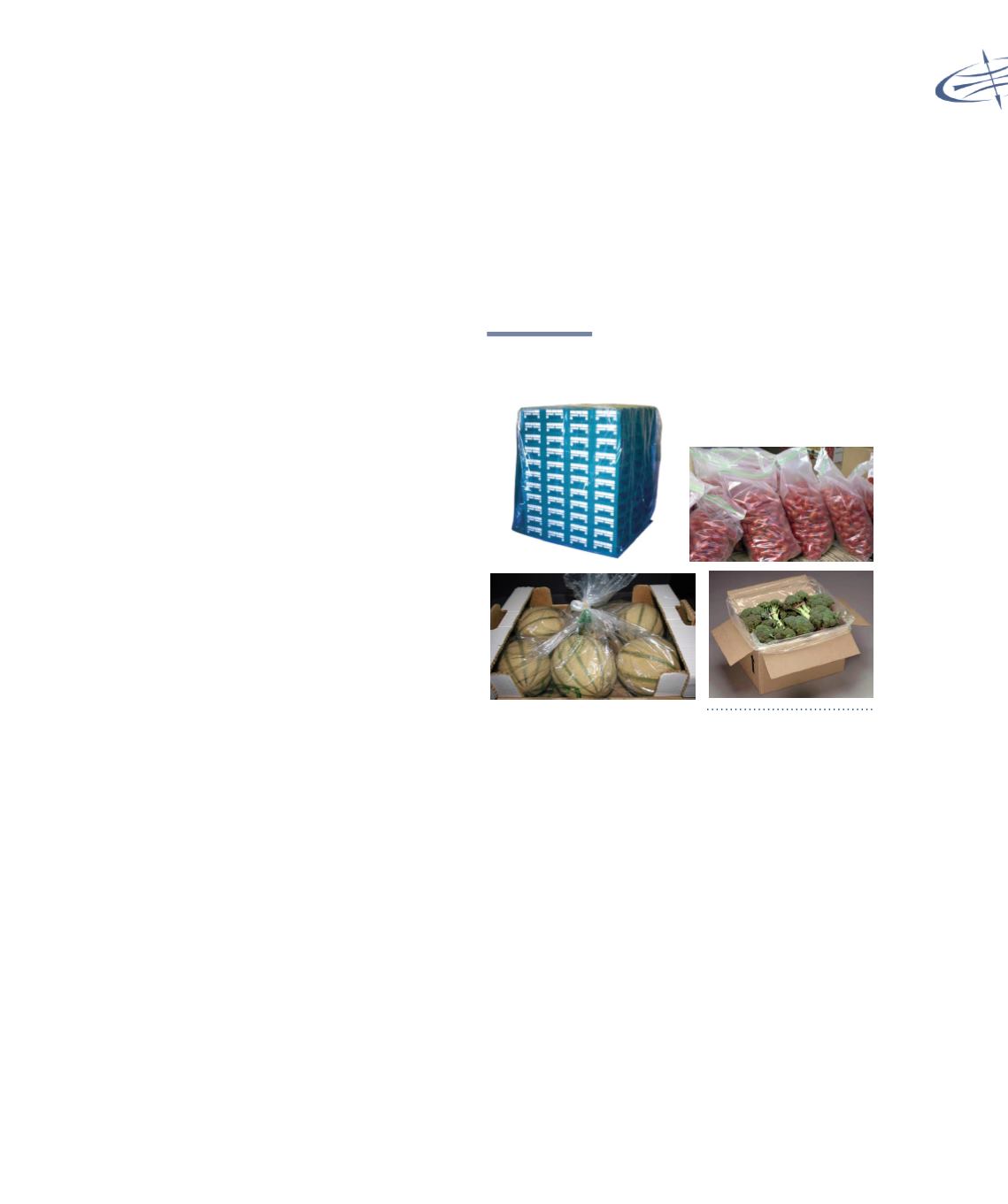
FIGURE 6.8
Ethylene absorbers incorporated
into plastic films
Source: Press Release
The function of the antimicrobial package is
to power up the same functions as the conventional
packages, which means, assure the safety, keep the
quality and extend the product shelf life. Besides, it can
reduce the potential of recontamination of processed
food and beverages, simplifying treatments that aim to
eliminate the contamination of package materials and
promote the auto sterilization, at least in theory, of some
products, like acid beverages such as fruit juices. They
can be sorted in two types: the ones in which the active
agent migrates to the surface of the food and the ones
in which it is effective without the need of migration.
Modified atmosphere packages with carbon
dioxide, which has fungistatic and bacteriostatic
activity, are examples of active antimicrobial packages.
Ethanol and CO
2
emitters in the form of sachets control
the growth of fungi on food and the contamination in the
packages. SO
2
emitters are used in the form of sachets/
pads or incorporated films to control the development
of fungi (
Botrytis Cinerea
) on grapes (Figure 6.9).
Antimicrobial active compounds can also
be incorporated in the package material. While
incorporated in plastic packages, they generate the
bioactive polymers. Various synthetic compounds (also
called chemicals), naturals compounds and probiotics
have had their antimicrobial potential analyzed, such
as the metallic ions, natural extracts, organic acids
and their salts, bacteriocins, fungicides, enzymes,
Antimicrobial packages