



 187 / 231

Brasil
PackTrends
2020
187
sustainability & ethics
It is also important to include analysis of
possible trade-offs, ie, environmentally unfavorable
possible points arising from the implementation of new
processes, such as the increase of emissions to water
when increasing the recycling rate or loss of packaged
products when reducing the mass of some packages
become more fragile and so on.
TheLifeCycleThinking, cancurrentlybeconsidered
as one of the most important tools for the development
of packaging and products that aim to become more
sustainable. For packages, this concept means to “rethink
the packaging associated with its lifecycle, challenging
their limits of weight, shape, materials and accessories,
without, however, compromising the integrity and
product shelf life.” When the wish to become less costly
to the environment becomes a goal clearly defined, it
reduces the weight of what is not essential; it goes to the
limits of technical requirements; it values the efficiency
more than appearance and it generates more responsible
packaging options.
When the relation between product or service
and the quantity of used package is optimized, the
consumption of natural resources is indirectly reduced,
such as oil, water, sand, coal and minerals, among
others, and, consequentially, the resulting emissions to
the air, water and soil. That way, the optimization of
materials should be one of the priorities in the search
for systems with less environmental impact.
This is also broadcasted internationally as the
concept of “Doing More with Less”, ie, regardless of
the material that you are using, it is important to try
to reduce their consumption, optimize its use and to
rethink the packaging so that can generate the same
products using less natural resources. A good example
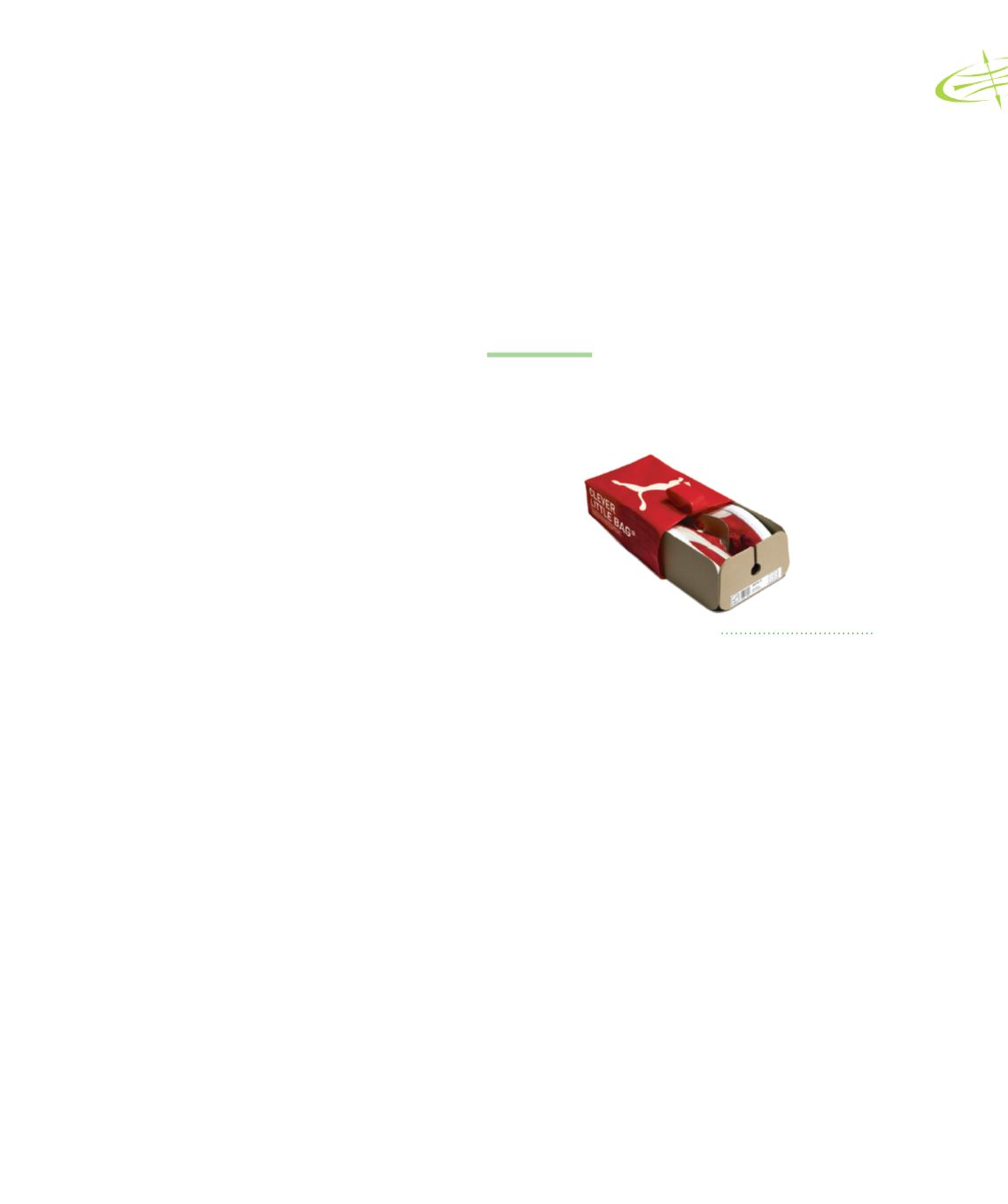
was the release of the Clever Little Bag, a new concept
for tennis packing shoes of brand Puma (Figure 7.6).
After months of a LCA study in the productive chain,
the box was radically reduced to an external recycled
bag and an internal skeleton-card for holding. Using the
concept of “use less”, Puma reduced in 65% the use of
cardboard, as well as plastic and diesel (DENT, 2011).
In this sense, one should highlight some
initiatives, due its relevance can be taken as examples.
The Walmart Corporate in Brazil, in a pioneer initiative
in the sector of sales and distribution, conscious of
its power as a retail company, challenges its suppliers
to rethink their products so that they can bring
environmental improvements.
FIGURE 7.6
Example of package
developed with the concept
“Doing More with Less”
Source: DENT, 2011
The Walmart Corporate in Brazil, in partnership
with the Packaging Technology Center of Food
Technology Institute (CETEA/ITAL) between 2009 and
2010, released the Project End-to-End, attended by
ten companies who presented after 18 months of work,
progress in environmental performance of its products
based on the principles of Life Cycle Thinking: 3M
Brazil (Curauá sponge), Cargill Agricola (Liza oil line),
CP Colgate-Palmolive (Pinho Sol disinfectant), Coca-
Cola Brazil (Matte Leão tea), Johnson & Johnson (Band-
Aid), Nestlé (Pureza Vital mineral water), Pepsico Brazil
(organic Toddy chocolate), Procter & Gamble (Pampers
total comfort diapers), Unilever Brazil (concentrate
Comfort fabric softner) and Walmart Own Brands
(Topmax bar of soap) (WALMART, 2010).
The success and the repercussion of the retailer-
manufacturer-research institute partnership initiative
brought the second edition of the same project,
developed between 2010 and 2011.
At this second edition the improvement actions
had to be necessarily implemented in both the supply and