



 192 / 231

Brasil
PackTrends
2020
192
sustainability & ethics
own containers to supply them from bulk containers
for products sold in bulk, as salt and rice. Although
consumers approve the idea, increased membership will
depend on the incentive schemes. Countries such as
the Netherlands, Denmark and Finland commercialize
80%, 90% and 98%, respectively, of beer and soft
drinks in returnable containers (BARNETT, 2010).
The redesign to “make packages reusable”, at a
minimum, doubles the life time of natural resources that
were consumed in the first product commercialization.
Some packaging formats naturally induce the reuse,
such as the new Anchor Packaging’s polypropylene
pot with red lid that replaces the single-use expanded
polystyrene version for side dishes such as mashed
potato, pasta with cheese, green beans etc. Through
consumer surveys, it has been found out that they prefer
reusable vessels because they give them the control of
how it is reused or disposed after the purchase. In order
to spread the reusability idea, KFC Reusable, Microwave
& Top Rack Dishwasher has been printed on the lid, in
high relief (
FIGURE 7.16
), informing that it is reusable
and safe for microwave and dishwasher uses (MOHAN,
2010).
FIGURE 7.16
Example of reusable package
Source: Press release
Recycling, since it originated from a process
with lower environmental impact, should be strongly
encouraged by the government, once it reduces the
pressure on the consumption of natural resources.
Various examples of packages manufactured with
recycled material have been observed in the market.
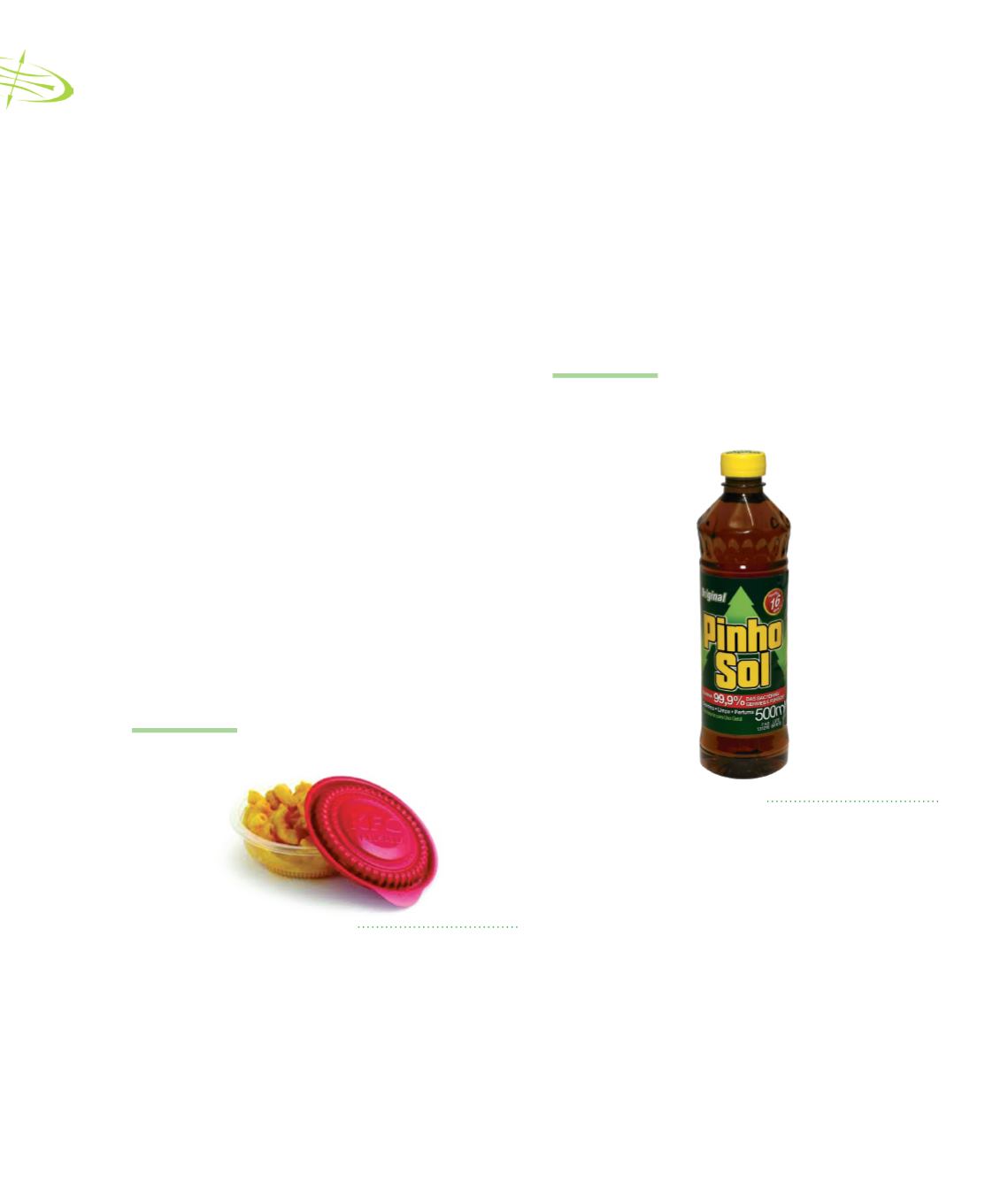
Colgate Palmolive has optimized its line of
disinfectants Pinho Sol with developments in various
aspects of the manufacturing process, even changing
the lighting of its production line by more efficient
systems, and also using a PET bottle 100% recycled
with 90% of material originated from post-consumption
and 10% from pre-consumption (
FIGURE 7.17
).
FIGURE 7.17
Example of the use of 100%
recycled PET bottle
Source: Walmart, 2010
Coca-Cola Brazil launched, in 2011, the 2.5
liters bottle containing 20% of post-consumer recycled
PET resin food grade (PCR PET). There is, currently, a
bottle-to-bottle recycling plant that was approved by the
Brazilian Health Surveillance Agency (Anvisa).
The recycled bottle (
FIGURE 7.18
) has the
same characteristics as produced from virgin PET
resin (COCA-COLA..., 2010). In this process, the used
bottles used are selected, crushed and washed by an
efficient process of decontamination and recovery of
the molecular weight of PET, removing contaminants
at levels required by food contact packaging legislation.
The clean material is then used in the manufacturing