




 64 / 231

Brasil
PackTrends
2020
64
fatores que influenciam o mercado de bens de consumo
generations of consumers, over time, and the emergence
of new lifestyles and consumption habits.
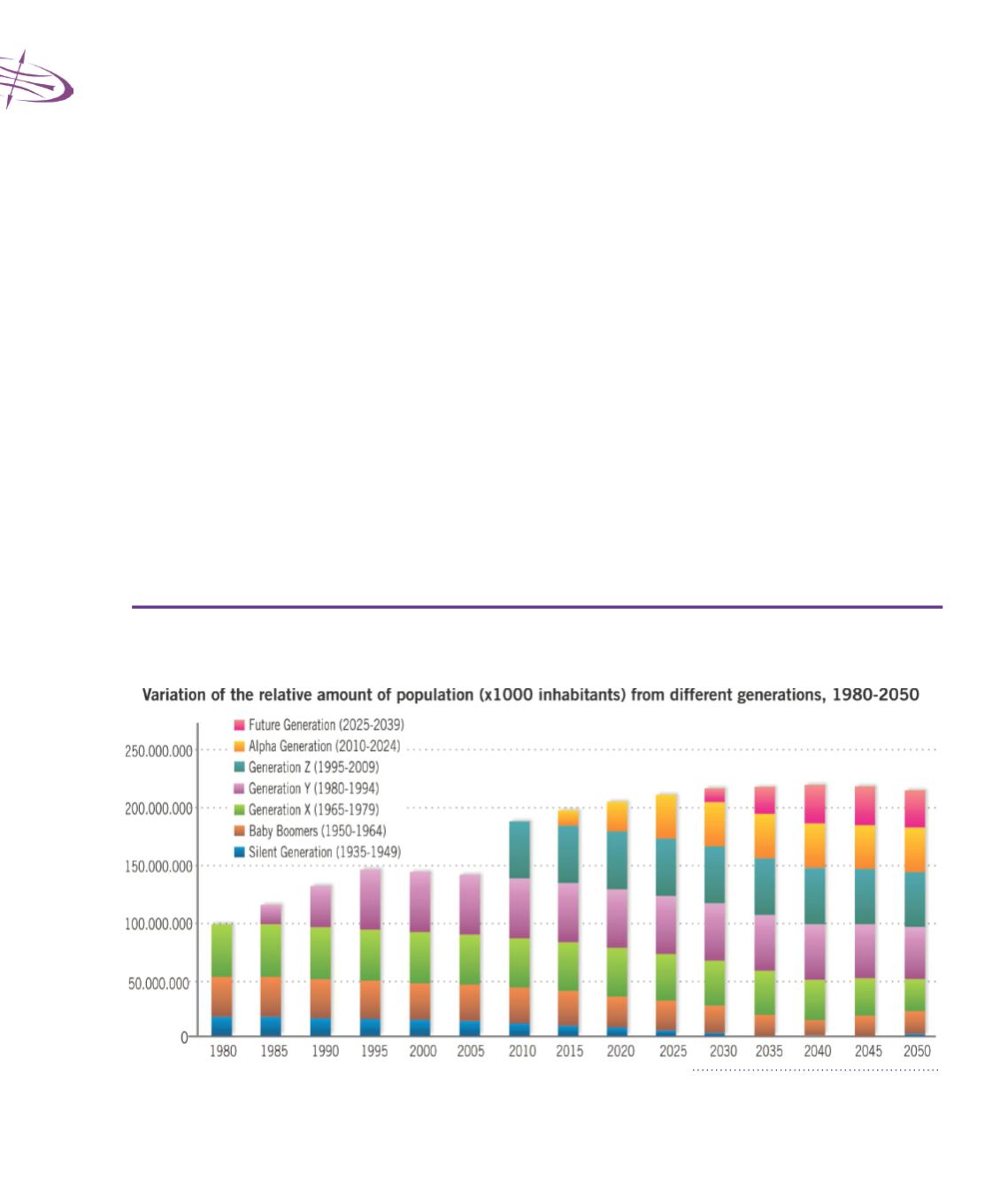
To assess the evolution of generations in the next
decades, the tabulation of data from the IBGE (2008) was
made and an own criterion for population segmentation
according to the generations (Picture 2.8) was adopted.
To facilitate the analysis, it was adopted as the standard
the time interval used in existing classifications of
generations Z (1995-2010) and Alpha (2010-2025),
just avoiding the overlapping of dates to avoid double
counting occurs. Thus, it has been agreed to classify
the Brazilian population in the following “generations”:
Silent Generation (1935-1949), Baby Boomers (1950-
1964), Generation X (1965-1979), Generation Y (1980-
1994), Generation Z (1995-2009), Generation Alpha
(2010-2024) and Future Generation (2025-2039).
Finally, inside a generation it is possible to find
different consumer segments, which further complicates
the use of this approach to explain the buying behavior and
consumption. This can be verified in the study of Boston
Consulting Group (BARTON; FROMM; EGAN, 2012),
which highlights six different groups of consumers: Hip-
ennial, Millenial Mom, Gadget Guru, Clean and Green
Millenial, Old-School Millenial e Anti-Millenial.
Therefore, care should be taken to stereotypes
that lead to misinterpretations about the segmentation
of the consumer market will not be created. Still,
the analysis of different generations of consumers is
considered useful to reflect on the factors that may
influence the packages sector in the future. Therefore,
there is a brief reflection on the potential impacts arising
from changes in the relative amount of the Brazilian
PICTURE 2.8
Variation of the relative amount of population (x1000 inhabitants) from
different generations, 1980-2050
Source: IBGE data, 2008 – own elaboration