




 92 / 231

Brasil
PackTrends
2020
92
convenience and simplicity
Taking into consideration the rhythm of
consumer’s lives, many food and drink companies are
searching to add practical benefits to packages focusing
on the moment of consumption, minimizing the use
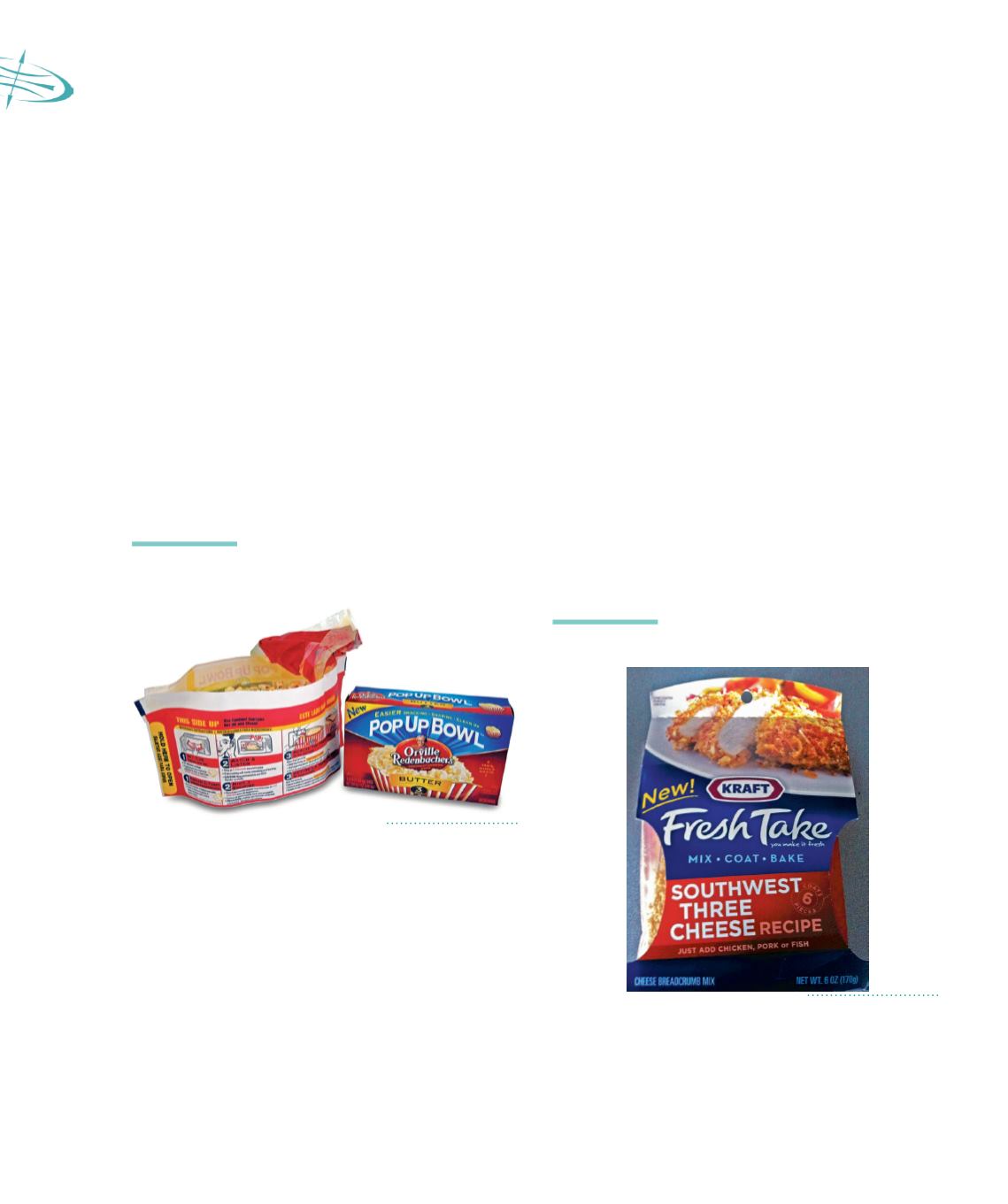
of cups, cutlery and other utensils. Recently, Orville
Redenbacher’s, a ConAgra Foods brand, released a
microwave popcorn package, with no need of traditional
bowls, as the package takes this very format at the end of
preparation (Picture 4.9). Besides, the package allows
you to see the corn popping and has a wide opening to
share the product with many people.
PICTURE 4.9
Package for product preparation
and consumption
Source: Press Release
Attending to the modern consumer demands,
which needs convenient products and packages,
quickly made, but without giving up of consuming
fresh and tasty products, Kraft Foods launched the
Fresh Take line. Fresh Take consists of a ready-
made mix of cheese and breadcrumbs, to be used
to enhance chicken, meat or fish dishes. Besides
its attractive appearance, the package is a pouch,
in which the ingredients are kept separated in two
compartments by a seal; the pouch itself contains
instructions on how to use and can be used to mix
these ingredients by simply tearing the central seal
(Picture 4.10).
The Swedish company OneCafe offers a fresh filter
coffee, with superior quality, brought from Uganda, in a
sachet package that is individual and easy to open and
discard. The package can be fixed to the side of the cup
where the coffee will be consumed, allowing the sachet
to later be placed back inside of it, avoiding spillage
(Picture 4.11). Another example is the Tstix package,
for soluble drinks such as teas and coffees. It is made
in the form of a stick, with perforations allowing the
flowing of hot water and the dilution of the product, still
serving for the homogenization, substituting the spoon
(Picture 4.11).
PICTURE 4.10
Package with multiple ingredients
Source: Press Release
For those who think about the glass packaging
industry as something stationary, with no room for
innovation, Owens-Illinois, in conjunction with a local
retail network in the United States, developed the
Simplicity of Use