Brasil
PackTrends
2020
170
qualidade & novas tecnologias
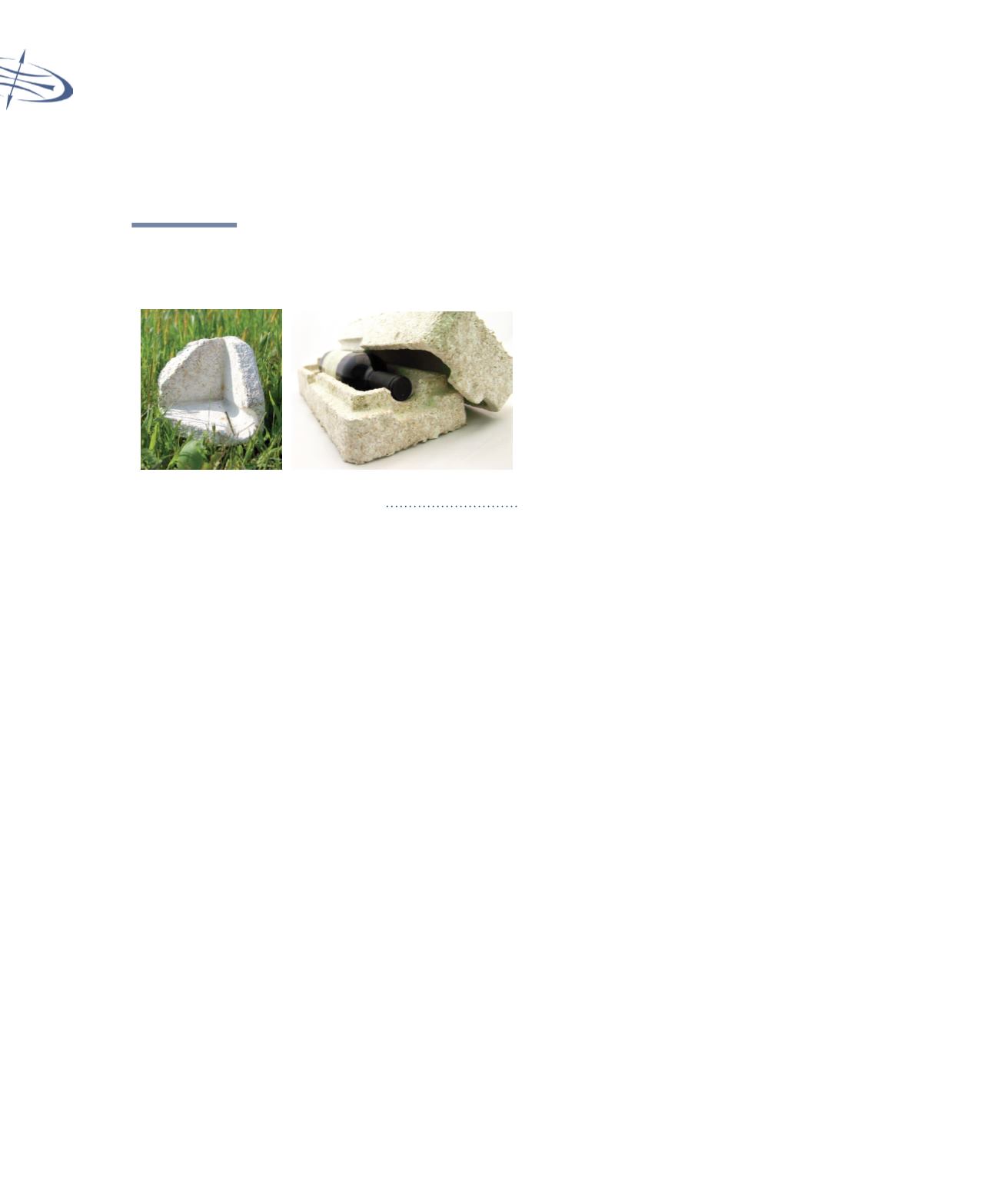
FIGURA 6.33
Exemplo de material
para acolchoamento com
apelo sustentável
Dentre os biopolímeros, além dos materiais ce-
lulósicos, o poli(ácido láctico) – PLA, polímeros à base
de amido e o Polietileno Verde da Braskem são os prin-
cipais produtos do mercado. Esse mercado de biopolí-
meros para embalagem é especializado e concentrado,
mas tende a ser mais fragmentado na próxima década.
Na área de biopolímeros, os desafios são: superar
as limitações nas propriedades, especialmente para uso
em embalagem de alimentos, aumentar a disponibilida-
de, aumentar a competitividade com polímeros de fonte
fóssil de menor custo e resolver questões ambientais:
impacto negativo na cadeia de reciclagem de outros
materiais, falta de coleta e infraestrutura para compos-
tagem. O futuro está nas embalagens fabricadas a partir
de resíduos/subprodutos das indústrias de alimentos,
bebidas, madeireiras e resíduos agrícolas.
ASSOCIAÇÃO BRASILEIRA DE NORMAS TÉCNICAS.
NBR 15448-
1
: embalagens plásticas degradáveis e/ou de fontes renováveis.
Parte 1: terminologia. Rio de Janeiro, 2008. 2 p.
ASSOCIAÇÃO BRASILEIRA DE NORMAS TÉCNICAS.
NBR
15448-2
: embalagens plásticas degradáveis e/ou de fontes
renováveis. Parte 2: biodegradação e compostagem - requisitos
e métodos de ensaio. Rio de Janeiro, 2008. 10 p.
ASTM INTERNATIONAL.
ASTM D 5488-94
: standard terminology
of environmental labeling of packaging materials and packages.
Philadelphia, 1994. Withdrawn 2002.
ASTM INTERNATIONAL.
ASTM D 6400-12
: standard specification
for labeling of plastics designed to be aerobically composted in
municipal or industrial facilities. Philadelphia, 2012. 3 p.
ASTM INTERNATIONAL.
ASTM D 6868-11:
standard specification
for labeling of end items that incorporate plastics and polymers
as coatings or additives with paper and other substrates
designed to be aerobically composted in municipal or industrial
facilities. Philadelphia, 2011. 3 p.
BARNETT, I.
The nanotechnology opportunity in food and drinks
packaging:
new products and benefits that will overcome
consumer skepticism and industry pricing concerns. London:
Business Insights, 2011a. 84 p.
BARNETT, I.
The global outlook for biodegradable packaging:
key trends
and developments driving the global biodegradable packaging
market. London: Business Insights, 2011b. 110 p.
DAY, B. P. F. Active packaging of food. In: KERRY, J.; BUTLER,
P. (Ed.).
Smart packaging technologies for fast moving consumer goods.
West Sussex: John Wiley & Sons, 2008. Chapter 1, p. 1-18.
DUNCAN, T. V. Applications of nanotechnology in food
packaging and food safety: barrier materials, antimicrobials
and sensors.
Journal of Colloid and Interface Science
, v. 363. n. 1, p.
1-24, 2011.
EUROPEAN COMMITTEE FOR STANDARDIZATION
. EN
13432:2000/AC:2005:
packaging - requirements for packaging
recoverable through composting and biodegradation - test
scheme and evaluation criteria for the final acceptance of
packaging. Brussels, 2005.
EUROPEAN COMMITTEE FOR STANDARDIZATION.
EN 14995
:
plastics - evaluation of compostability - test scheme and
specifications. Brussels, 2006.
HAN, J. H. Antimicrobial food packaging.
Food Technology
,
Chicago, v. 54, n. 3, p. 56-65, 2000.
HAN, J. H. Antimicrobial food packaging. In: AHVENAINEN,
R. (Ed.)
Novel food packaging techniques.
Boca Raton: CRC, 2003.
cap. 4, p. 50-70.
HAN, J. H. Antimicrobial packaging systems. In: HAN, Jung
(Ed.).
Innovations in food packaging
. San Diego: Elsevier, 2005.
cap. 6, p. 80-107, 2005.
HORTON, N.
Trends in ethical and sustainable packaging
: innovation
by product category. London: Business Insights, 2008.
6.5 REFERÊNCIAS
Fonte: Divulgação


